
At my firm, Birdsmouth Design-Build, we have been noticing that our clients are starting to ask for resiliency features in their homes more often. Everything from fire mitigation to protection from heat domes and cold snaps to earthquakes and other natural disasters. But one of the most common and expensive threats to any home is far more mundane: water leaks.
Water damage isn’t just inconvenient—it’s costly. In fact, water-related insurance claims are the second most common type in the United States, often exceeding $10,000 per incident. Beyond the financial toll, water intrusion can lead to mold, rot, structural degradation, and even long-term health problems.
But how do we mitigate water risks to make our homes more resilient without breaking the bank? Recently, Randy Williams (as part of this week’s resiliency and affordability series) asked me to consider some ways to address affordability and resiliency in buildings. I believe there is a way to accomplish both by leveraging costs and realizing savings over time.
First costs and the importance of design
Resilience to water damage starts with smart design. The layout of your home, particularly the placement of plumbing and mechanical systems, can dramatically reduce the chances of leaks—and make them easier to spot, contain, and fix when they do occur.
Start by designing all wet areas—kitchens, bathrooms, laundry rooms—near one another. This reduces the need for long plumbing runs and consolidates water lines to a single area. Not only does this save on material and labor costs, but it also simplifies maintenance and troubleshooting down the line. And if there is a leak, it will be contained to just one part of the building.
If possible, locate the water heater near the fixtures it serves. Shorter hot water lines mean faster delivery and reduced heat loss—a win for resilience, a win for comfort, and a win for efficiency. A shared plumbing wall between bathrooms or between a kitchen and a laundry room streamlines installation and allows for a single plumbing vent, minimizing penetrations through the building enclosure—another common weak point for air and water leaks. Minimizing the number of plumbing lines is minimizing the potential for leaks.
Keep it inside
One of the most important design principles for a water-resilient home is keeping all plumbing within the conditioned enclosure. Plumbing in exterior walls, vented crawlspaces, or attics is harder to insulate effectively and more prone to freezing during cold weather. Frozen pipes can burst, leading to catastrophic water damage in just minutes.
Designing the building envelope to fully enclose plumbing—not only walls but crawlspaces and attics—adds a critical layer of protection. A conditioned crawlspace, in particular, offers an ideal location for running plumbing: it’s visible, accessible, and less likely to freeze. If a leak occurs, it’s easier to detect and repair without damaging finishes or furnishings.
Inaccessible plumbing connections, whether buried in walls or hidden in unconditioned attics, should be avoided whenever possible. A hidden leak might go undetected for months, leading to rot, mold, or worse.
Drain pans: A cheap and smart investment
Where water is used or stored, it’s wise to plan for failure. Appliances, HVAC equipment, condensate lines, and water heaters should be placed in drain pans. Basic plastic pans cost as little as $20—a small price to pay for a big potential savings down the road.
For higher-risk installations or where a leak might go unnoticed for longer, consider custom drain pans with drains piped to a safe discharge location. These require a P-trap and primer to keep sewer gases from getting into the home, but they add a serious layer of protection, especially in multistory homes or those with finished basements.
Smarter piping = fewer problems
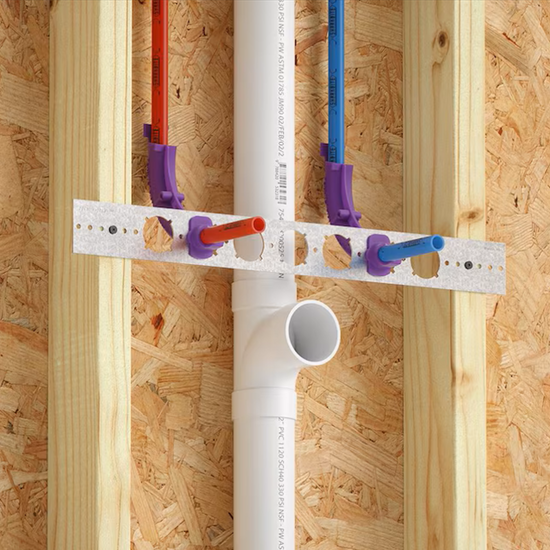
PEX piping has become the standard for many builders—and for good reason. Unlike rigid materials, PEX can expand and contract, making it far more tolerant of freezing events. It’s also easier to install and less prone to joint failures, especially when bend supports are used in lieu of traditional 90-degree elbows. Every connection, after all, is a potential leak point.
Bend supports, which are relatively inexpensive, not only reduce the need for fittings but also streamline the installation process, potentially reducing overall costs. The fewer the connections in a system, the fewer the opportunities for failure.
Water-leak detection
Even with excellent design, leaks can still happen. That’s where technology can play a role. A whole-home leak-detection system offers a final layer of defense.
Some of these systems monitor one’s water usage and can detect abnormal patterns—such as a running toilet, a leaking irrigation system, or a slow drip behind a washing machine. Some systems can even shut off the water automatically if a major leak is detected, minimizing damage while you’re away.
Leak detectors aren’t just smart—they can also save you money. Many insurance companies offer premium discounts for homes equipped with leak-detection systems, often between 3% and 10%, with some discounts reaching as high as 15%.
That savings adds up quickly, especially when you consider the cost of a single undetected leak—not just in water bills, but in drywall repair, flooring replacement, and the emotional toll of dealing with insurance claims and disrupted living spaces.
We have installed the Phyn smart water-leak sensor in two projects now. One was a retrofit where the homeowner had been surprised by a stratospheric water bill due to her irrigation system leaking without her knowledge. Another was for a new home where we installed a concrete-free slab on grade. We wanted to make sure that if a water leak happened, it would be stopped right away. This particular system has an automatic shutoff feature that will turn off the water main if a leak is detected.
The true cost of inaction
It’s tempting to think of water resilience as an “upgrade”—something to do if the budget allows. But with smart design and a handful of cost-effective strategies, resilience can be built in from the beginning. Many of the most effective solutions—shared plumbing walls, shorter runs, PEX bend supports, drain pans—cost little or nothing more than conventional alternatives. These resilience strategies can potentially save some first-time costs and over time add up to a good investment. So the real question becomes: Can you afford not to build this way?
Josh Salinger is the founder and CEO of Birdsmouth Design-Build,a residential construction companyin Portland, Ore.