
Green Building Advisor - Wildfire Resilience: Rebuilding After the Fire
January 14, 2026, by Joshua Salinger
Evan and Linda had lived for decades on a gorgeous stretch of the Clackamas River outside Portland, Oregon. Linda grew up in the house, and together they came to love the privacy, wildlife, and sweeping river views that came with being tucked into the forest.
That same forest, however, put them directly in the path of the 2020 Labor Day wildfires. When the human‑caused Dowty Road Fire—driven by extreme winds and years of drought‑stressed timber—swept through, Evan and Linda escaped. Their home did not.
When they returned, they found that the house had been reduced to ash. A brick chimney, a burned‑out car, and a few scorched remnants of the landscape were all that remained. The well and septic system, just beyond the fire’s reach, survived; the foundation, driveway, and most other infrastructure were destroyed. They had insurance, but the payout fell short of what it would take to rebuild, leaving them to cover a roughly one‑third funding gap on their own.
In January 2021, Evan turned to the Green Building Advisor community with some questions: Who to talk to first? Architect? Design/build firm? Passive House or Pretty Good House? How does one identify a reliable builder who understands high performance and quality? What questions should I even ask?
That post became a GBA Q&A Spotlight. I responded with some resources and course suggestions, never imagining it would lead to a project. Evan already knew our company, Birdsmouth Design-Build, from a 2019 GBA article, “Insights from a Practical Passive House,” and had been quietly following our work. This turned into a phone call, a few meetings, and eventually a partnership to craft him and Linda a new high-performing and fire-resilient new home.
Program and performance goals
From the outset, Evan and Linda envisioned a compact, two‑story home of about 2,000 sq. ft. with three bedrooms, three baths, an exercise room, and an office or bonus space. They wanted generous east‑facing glass overlooking the river, an attached two‑car garage with workshop, and a small, attached storage area. A slab‑on‑grade foundation with zero threshold and universal design features would allow them to age in place.
Evan, an engineer by training, was drawn to high‑performance building in part because their previous house had so many problems: poor insulation, random stud spacing, haphazard plumbing, ungrounded electrical work, chronic mouse issues, a drafty masonry fireplace, and steep, narrow stairs that had caused multiple falls. He and Linda wanted a home that was the opposite—tight, quiet, comfortable, and durable.
They came to the table with a clear set of goals: exceptional indoor air quality to mitigate more frequent smoke events and Evan’s seasonal allergies, a simple and efficient building form for energy efficiency, fire resilience and cost savings, aging‑in‑place details (including stair geometry that could accommodate a future stair lift), a robust enclosure that could ride out frequent power outages, long‑term durability with low maintenance, and a level of comfort that their previous home could never deliver. Wildfire resilience was central, but they also wanted a home that would perform every day of the year, not just in an emergency.
To certify or not to certify …
Evan and Linda were interested in both Passive House and Pretty Good House, and after reviewing the pros and cons together, we chose to pursue Phius certification. The Phius standard aligned with all of their goals, and Evan was committed to rigorous energy modeling from the outset. Our team already performed in‑house modeling with WUFI Passive software, and we prefer having a third party confirm performance and check our work anyway, so Phius was a natural fit. We had been building to the Phius standard for years, regularly achieving better‑than‑required airtightness on first blower‑door tests, and had grown to understand this approach as simply best practice from design to build through final commissioning. Generous incentives from Energy Trust of Oregon—even some specific to fire rebuilds—more than covered the cost of certification, making the decision straightforward for everyone involved.
Overcoming constraints with physics, budget and creativity
The property’s grandfathered status allowed a new home in essentially the same location—a rare opportunity, given current restrictions on building directly alongside the river. That location, however, came with difficult access.
Reaching the site requires navigating a narrow, winding driveway with steep sections, tight turns between large Douglas‑fir trees, crossing a neighbor’s property, and a tight turnaround. Concrete trucks could make it in with careful navigation. Roof trusses were another story; after visiting, the truss supplier declined to deliver, citing access and safety concerns.
Local Christmas tree farms provided an unexpected model. In the area, helicopters are often used during harvest to move trees from remote locations to staging yards. The same approach turned out to be viable for trusses. A local operator quoted a rate that was comparable to standard truss delivery and less than many crane rentals. So we had a helicopter day. It was a good reminder of what this work often looks like in practice: overcoming logistical hurdles with a blend of physics, budget constraints, and creativity.
Passive buildings are inherently more fire resilient
Most people think of Passive House primarily as an energy standard. In the WUI, the same strategies that cut energy use also improve life safety and resilience.
A home needs three things to burn: fuel, heat, and oxygen. We can’t control the oxygen, but we can dramatically reduce the fuel on and around the home and limit the amount of heat that reaches that fuel. Often, fires are started due to the heat from radiation traveling through the glazing and becoming hot enough on the interior to start curtains, blinds and interior finishes ablaze. By employing triple-pane windows, one is significantly reducing the transmittance of heat from outside to inside and reducing this potential pathway for fire to take hold. Additionally, the three panes are more structurally robust, as there is an additional pane of glass that would need to shatter to get heat and embers access to the interior.
An airtight passive building minimizes gaps and cracks where embers and hot gases can enter, and it reduces uncontrolled air movement within assemblies that might otherwise help a fire spread. Additionally, balanced mechanical ventilation keeps interior and exterior pressures closer to neutral, reducing infiltration that can draw smoke and embers into the building. None of these measures make a house “fireproof,” but together they remove several common ignition pathways that legacy buildings typically leave open.
Defensible space
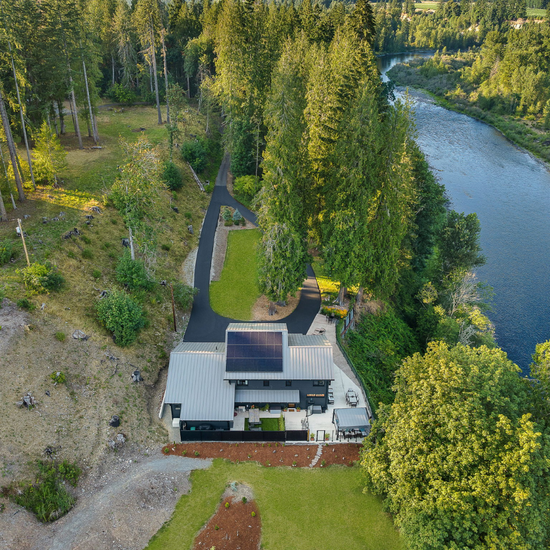
The first line of wildfire defense is not the wall assembly or the materials it is composed of; it is the landscape. At Evan and Linda’s home, defensible space is organized into three zones, the Immediate Zone, the Intermediate Zone, and the Extended Zone.
The Immediate Zone, from 0 ft. to 5 ft., is a strictly noncombustible buffer space. Against the mineral‑wool‑insulated stem wall, a 12‑in. band of river rock discourages vegetation right at the foundation and provides a durable, low‑maintenance finish. Beyond that, hard surfaces—concrete patio, asphalt driveway, and gravel walkways—wrap the rest of the perimeter. To keep some greenery near the entries without adding fuel against the home, plantings are limited to pots that can be moved quickly when fire risk is high.
The Intermediate Zone, from 5 ft. to 30 ft., is designed to limit flame length and radiant heat. Much of this band is occupied by patios and driveway. On the back side of the home, the neighboring property has low shrubs but no trees, woodpiles, or tall, dry grasses close to the shared boundary. On the upslope, the plan is to maintain low native plants, grasses, and herbs that stabilize the soil without creating ladder fuels that could carry fire into tree canopies or toward the home.
The Extended Zone, from 30 ft. to 100 ft. and beyond, focuses on managing the surrounding forest. Trees are limbed up to at least 6 ft. or three times the height of nearby shrubs, whichever is greater. Dead trees and woody debris are removed regularly, and live trees are spaced to reduce crown‑to‑crown transmission. Together the three zones make the property more defensible for firefighters and less likely to serve as a source of ignition for Evan and Linda’s home.
Roof and vent strategy in the WUI
From a fire perspective, the roof is often the most vulnerable part of a house. For budget and architectural reasons, we used a vented truss roof, with a foam‑free vented assembly, over the main living area to create some interior volume and daylight.
Because vents are a prime entry point for embers and flames, soffit openings were fitted with Vulcan Vents. These incorporate a stainless‑steel mesh that blocks small embers, which often arrive long before the fire. Along with this, the vents have an internal honeycomb matrix coated with an intumescent material. Under normal conditions, they allow ample airflow for roof ventilation. Under high heat, the coating expands, effectively sealing the vent and creating a temporary fire barrier and reducing the potential for ignition.
The choice of roof cladding also supports resilience. A standing‑seam metal roof is noncombustible, durable, and low‑maintenance, and it simplifies solar PV attachment. At the end of its service life, the metal is recyclable, which fit well with Evan and Linda’s broader sustainability goals.
Walls, insulation, and rainscreen details
On the walls, Evan originally was interested in mineral wool with its Class A fire rating. Unfortunately, the pandemic was in full swing during the design phase of this home, and reductions in manufacturing and high demand meant that we were unable to get our hands on any. So we moved to the next best option, which turned out to be cork. Although it doesn’t have an ASTM rating, it does have a European class E designation, meaning it is slow to burn, doesn’t easily spread flames, doesn’t release toxic gasses when charred, offers good fire protection without added retardants, and can resist burn-through for significant periods. On top of that, it dovetailed nicely with Evan and Linda’s low embodied carbon goals for their home. On-site it proved easy to work with, cutting cleanly and avoiding the plastic debris associated with foam boards.
Behind the cladding, we needed a vented and drained cavity that balanced moisture performance with fire behavior. Research indicates that gaps larger than roughly 3/8 in. promote convective drying, while cavities larger than about 3/4 in. can facilitate fire spread. To thread that needle, we used 1/2‑in. vertical battens over the cork to create a drained and ventilated rainscreen cavity.
Ember exclusion at the cavity edges and penetrations was another priority. At the base and top of the walls and around every opening— windows/doors, HVAC terminations, plumbing vents, hose bibs, and electrical boxes—we installed custom‑bent stainless‑steel screens. These screens are fine enough to block embers, durable enough to last the life of the cladding, and inherently noncombustible.
Cladding, flashings, and trim
The primary wall cladding is horizontal fiber‑cement lap siding, chosen for its noncombustible characteristics, durability, and relatively modest maintenance requirements. To soften the exterior and create a welcoming entry, vertical FSC‑certified cedar appears near the front door, tucked under the covered entrance.
At window and door sills—common points of ember accumulation—all flashings are metal. This avoids combustible horizontal elements at key ledges while providing robust drainage and protection for the assemblies below. The combination of noncombustible cladding, careful detailing, and ember‑resistant rainscreen openings helps limit the home’s vulnerability to wind‑driven firebrands.
Enclosure specs and airtightness
The completed home has 2,467 sq. ft. of conditioned floor area, a 904-sq.-ft. attached garage, and a 101-sq.-ft. attached storage space. The plan includes two primary suites (one on each level), with the upper suite served by stairs laid out to accommodate a future stair lift. An exercise room, an office/flex room, a generous living and dining area with large east‑facing windows, a laundry room, and a third full bath round out the program.
Thanks to orientation, disciplined window placement, and a simple building form, the required insulation levels for Phius certification in Climate Zone 4C were relatively modest: R‑21 under the slab, R‑27 in the above‑grade walls, and R‑43 to R‑60 in the roof, depending on assembly. Triple‑pane windows from Innotech with a U‑factor of 0.16 complement the enclosure. A final blower‑door test measured 0.041 cfm per sq. ft. of enclosure area, well below the Phius airtightness requirement and a key contributor to indoor air quality, comfort, efficiency—and fire resilience.
Mechanical design and air quality
The mechanical system centers on a Minotair unit that provides heating, cooling, and balanced ventilation with heat recovery. To extend its capabilities (as it was undersized on its own), we paired it with two supporting systems.
A SanCO2 heat‑pump water heater supplies auxiliary space heating via a hydronic heat exchanger installed in the main supply duct, post Minotair. This configuration allows the water heater to share its capacity with the air distribution system when needed during peak events, improving capacity and efficiency.
A buried water/glycol loop under the home provides preconditioning of incoming air. A small, thermostatically controlled 60W pump circulates the liquid when outdoor temperatures fall below about 42°F or climb above roughly 85°F, delivering up to 10° to 12° of “free” preheating or precooling from the ambient ground temperature before air reaches the Minotair. This reduces the load on active equipment and smooths indoor conditions during extremes.
Filtration was a priority because of pollen and smoke. The system uses a MERV 8 prefilter ahead of the heat exchangers and a MERV 14 filter in the Minotair. During the first year of operation, performance monitoring and minor adjustments were necessary to get the ground loop, post‑conditioning coil, Taco X block, SanCO2, and Minotair working together smoothly. Once tuned, the system has operated quietly with low energy consumption and has consistently provided high comfort.
All‑electric operation with backup
For everyday use, the home is all‑electric. An 8.4‑kW solar PV array mounted on the standing‑seam metal roof offsets the annual energy consumption to zero. The house is wired for future EV chargers, uses a heat‑pump clothes dryer, and relies on an induction range for cooking—eliminating indoor combustion and its associated pollutants.
Because the site experiences frequent and sometimes extended power outages, a propane generator provides backup. In a more urban context, batteries might have been the preferred solution, but here a generator offered a reliable, cost‑effective way to keep critical loads operating during multi‑day outages. Combined with the high‑performance enclosure, this backup strategy allows the home to maintain safe temperatures and basic functionality even when the grid is down.
Living in the new home
Evan and Linda recently celebrated their second year in the house. By their account, the most noticeable differences from their old home are comfort, quiet, and air quality. Temperatures are even, surfaces are warm in winter and cool in summer, and drafts are gone. During pollen season and wildfire smoke events, indoor air remains clear and comfortable, making the house feel like a refuge rather than a liability.
The generator has started automatically during outages, preventing the cold, dark stretches they once took for granted. Large panes of glass rise from the main floor to the vaulted ceiling, framing the Clackamas River and its daily traffic of osprey, eagles, rafters, and fisherfolk. The home’s performance recedes into the background, which is exactly the point—it lets them focus on their life, not on their building systems.
Perhaps most importantly, they now live in a home that acknowledges the realities of their site—wildfire, outages, and aging in place—and responds to them thoughtfully. It is not invulnerable, but it is significantly better prepared than the house they lost. For all of us involved, the project turned a devastating event into an opportunity not just to rebuild, but to build something enduring, efficient, and resilient—not to mention to gain some new lifelong friends.
Josh Salinger is the founder and CEO of Birdsmouth Design-Build a residential construction company in Portland, Ore.